

If you drive in New Jersey, you know how often large trucks are right there with you in traffic. You might pass tractor-trailers on the New Jersey Turnpike, merge near commercial vehicles on I-95, I-78, or I-80, or travel near warehouses, ports, industrial parks, and delivery routes where freight traffic is constant.
Most drivers are simply trying to get to work, pick up their children, run errands, or make it home safely. But when a truck accident happens, everything can change in seconds. A collision with a commercial vehicle can leave someone seriously injured, unable to work, without a usable vehicle, and unsure what to do next.
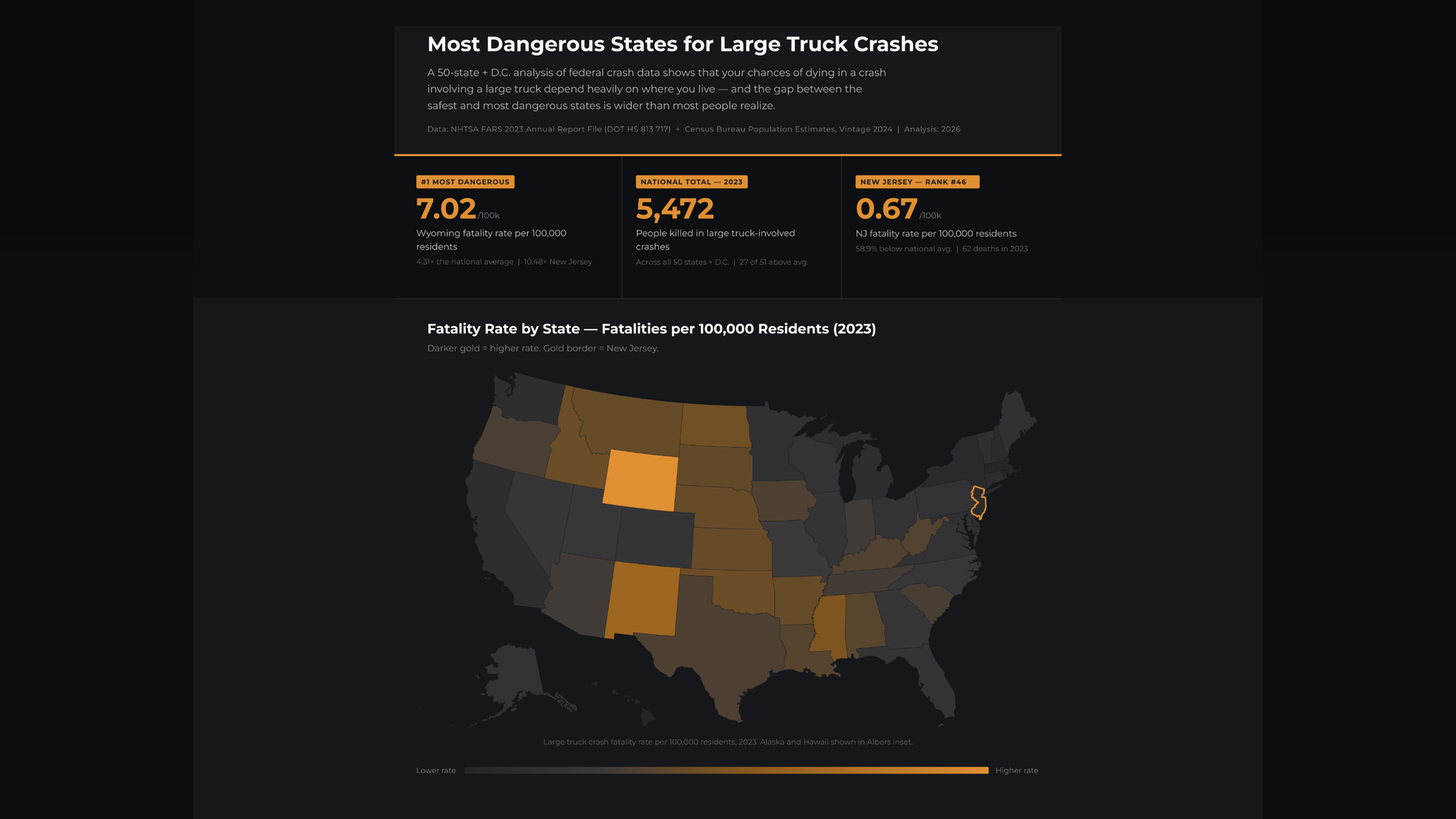
As part of our roadway safety research at the Law Offices of Harold J. Gerr, we examined 2023 federal crash data for our study, “Most Dangerous States for Large Truck Crashes.” The study looks at where crashes involving large trucks turn fatal, how fatality rates vary from state to state, and how New Jersey compares. For local drivers, the most important takeaway is not just where New Jersey ranks, but what the data tells us about sharing the road with large trucks every day.
We understand how quickly a serious crash can disrupt your life. Data can help explain broader roadway safety patterns, but when you or someone you love has been injured, the focus should come back to your crash, your injuries, and the evidence needed to understand what happened.
New Jersey’s Large Truck Crash Fatality Rate Is Lower, But the Risk Is Still Real
One important finding from the study is that New Jersey had one of the lower fatality rates for crashes involving large trucks on a per-person basis. New Jersey ranked 46th among the 50 states and Washington, D.C., with a fatality rate of 0.67 deaths per 100,000 residents in 2023.
That rate is well below the national average of 1.63 fatalities per 100,000 residents.
For many New Jersey drivers, that can seem surprising. Our state has heavy traffic, crowded highways, busy interchanges, and major freight corridors. Large trucks move through New Jersey every day carrying goods between ports, warehouses, distribution centers, retail locations, and other states.
The lower fatality rate does not mean truck accidents are not a serious concern here. The study still found that 62 people died in New Jersey crashes involving large trucks in 2023. Behind that number are families, emergency calls, hospital visits, and lives changed in ways a statistic can never fully explain.
That is why the data should be read carefully. New Jersey compares favorably to many other states, but a serious truck accident in New Jersey can still be catastrophic for the people involved.
Why Road Conditions Matter in New Jersey Truck Accidents
The study found that many of the states with the highest fatality rates for crashes involving large trucks are rural. Those states often have long highway stretches, higher travel speeds, fewer barriers, less lighting, greater distances between communities, and longer waits for emergency responders.
That does not mean crowded New Jersey roads are safe from serious crashes. It means truck accident risk depends heavily on the road environment.
New Jersey has heavy freight traffic, but it also has dense infrastructure, shorter distances between towns, more nearby hospitals, more emergency responders, and fewer long stretches of isolated rural roadway. Those factors help explain why the fatality rate is lower here than in many rural states.
Still, our state has its own dangers. New Jersey roads often place commuters, tractor-trailers, delivery vehicles, buses, motorcycles, and local drivers into tight spaces. A lower statewide fatality rate does not erase the risks on the Turnpike, I-95, I-78, I-80, Route 1, Route 18, I-287, and other heavily traveled roads.
How Freight Traffic Affects Everyday Drivers
For New Jersey drivers, the real takeaway is that truck accident risk is not only about how many trucks are on the road. It is also about where those trucks are traveling, how traffic is moving, and what conditions exist when something goes wrong.
Many crashes happen in situations local drivers recognize immediately. Traffic slows suddenly near an exit. A tractor-trailer changes lanes in heavy congestion. A passenger vehicle tries to merge into a tight space. A delivery truck stops on a local road. A large truck approaches a toll area, ramp, or construction zone where vehicles are moving unpredictably.
Large trucks need more time and distance to stop than smaller vehicles. They also have larger blind spots and can be harder to maneuver in heavy traffic. When those realities combine with speed, distraction, fatigue, poor weather, unsafe lane changes, or mechanical problems, the consequences can be severe.
Federal large truck crash data shows how serious those consequences can be nationwide, especially for people in passenger vehicles, pedestrians, bicyclists, motorcyclists, and others outside the truck.
For someone injured in a crash, the details matter. It is not always enough to know that a truck hit a car, or that several vehicles were involved. The more important question is what happened before the crash and whether the collision could have been prevented.
Why the First Explanation of a Truck Accident Is Not Always Enough
A truck accident can be more complicated than a typical car accident. Depending on what happened, it is important to look beyond the truck driver’s actions and consider the trucking company’s role, vehicle maintenance, cargo loading, ownership, and other details that help explain how the crash happened.
That does not mean every truck accident involves multiple responsible parties. It means the facts should be examined carefully before anyone accepts an insurance company’s version of what happened.
The first explanation of a crash is not always the full story. A police report can provide important information, but it does not always answer every question. Insurance companies often move quickly after a serious accident. Evidence can also disappear if it is not preserved early.
A careful review can include the police report, photos, video footage, witness statements, vehicle damage, medical records, driver logs, electronic data, maintenance records, delivery schedules, and information about the roadway itself.
This is where broader traffic data can be helpful. It can help attorneys understand patterns involving freight routes, roadway conditions, congestion, and crash severity. But the data never replaces the facts of an individual case.
At the Law Offices of Harold J. Gerr, we look closely at those details because the strength of a claim depends on the specific facts of the crash, the injuries involved, the medical treatment needed, the income lost, and the evidence available to show what happened.
How Can New Jersey Drivers Stay Safer Around Large Trucks?
No driver can control every risk on the road, especially on busy freight corridors. Still, awareness can help.
Give large trucks more room than you would give a passenger vehicle. Avoid traveling alongside a truck longer than necessary, especially near the trailer where blind spots are larger. Be cautious near ramps, toll areas, construction zones, and highway merges where traffic can shift quickly.
Do not cut closely in front of a truck, even if traffic is moving slowly. If the driver needs to brake suddenly, the truck might not be able to stop in time. In bad weather, at night, or in heavy congestion, leave extra space and avoid sudden lane changes whenever possible.
If a crash happens, your health should come first. Call 911, seek medical attention, report the accident, take photos if you can do so safely, gather available information, and avoid making assumptions about fault before the facts are reviewed.
It is also wise to be careful when speaking with insurance companies after a serious truck accident. Early statements can matter, especially when multiple vehicles, commercial policies, or disputed facts are involved, so it can help to understand your rights before answering detailed questions about the crash.
Injured in a New Jersey Truck Accident? Contact the Law Offices of Harold J. Gerr
Statewide data can help explain where serious truck crashes happen and why roadway conditions matter. But when you are the person injured in a crash, the issue is no longer national data. It is your medical care, your income, your pain, your family, and your future.
Our firm helps injured individuals and families throughout Central New Jersey understand their rights after serious truck accidents and other motor vehicle crashes. We know how disruptive these cases can be, and we understand why careful investigation, clear communication, and practical guidance matter from the start.
If you or someone you love was injured in a crash involving a large truck in New Jersey, contact the Law Offices of Harold J. Gerr today for a free consultation. We can review what happened, explain your options, and help you understand the next steps that may be available.
Disclaimer: This blog is for informational purposes only and does not provide legal advice. Reading this blog does not create an attorney-client relationship. Every case is different, and you should speak with an attorney about your specific situation.